Showing posts with label Discussion. Show all posts

Friday, 3 May 2013

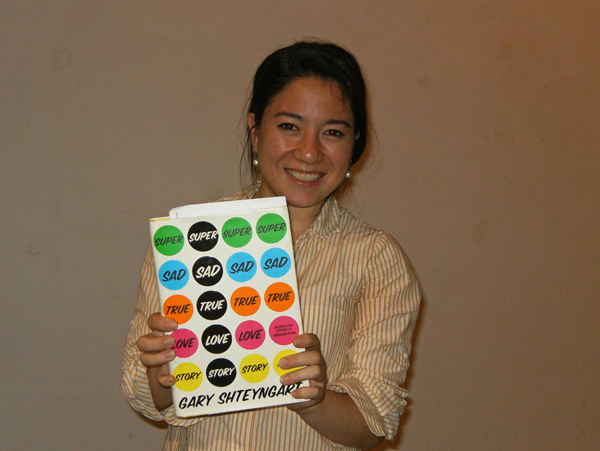
"Super Sad True Love Story" by Gary Shteyngart


"Super Sad True Love Story" by Gary Shteyngart

On Thursday 2nd May 2013, the Hove Book Group (HBG) gathered for another evening of top flight cultural discourse.  Tristan had chosen "Super Sad True Love Story"  by Gary Shteyngart for our consideration.  Tristan has a long and illustrious history of choosing provocative and interesting titles.  To the amazement of the group he confessed that someone at work had suggested this book and, as he happened to have the book on his shelf, he went for it.  Would such a cavalier approach to selecting a book come back to haunt him?

Tristan kicked off the discussion by stating he "really, really liked it" and lauded its "big themes".  

Tristan: "Big themes"
The book is set in the very-near-future: the dollar is in free-fall, the streets are filled with privatised soldiers, China might invade, the information age dominates life.  Most professional jobs are in media or credit. People stream information about each other on their "apparati" (alarmingly smart smart-phones). Books are deeply unfashionable – apart from anything they smell.  Tristan believes that the world depicted in the book is all too plausible, and this book is rich and amusing.  He also took time to praise the Joshie character, and Jeffrey Otter.  And why not?  8.5/10

Hamish" "Modern life is rubbish"
Hamish could not attend in person however conveyed these thoughts... "My Nee-groes, I had such high hopes.  Such high hopes.  A Tristan choice.  A concept seemingly on a par with "The City and The City" (my personal Booker of Bookers).  The downfall of the American dream.  It should have been great.  And to be fair, Gary is a very good writer.  In the sense that he knows and uses the English language quite beautifully at times at least.  Unfortunately, I felt no empathy at all with the characters (except Eunice's mother - "Please forgive you do not understand my English." "I know sometimes life is suck.").  Eunice Park appears selfish.  Lenny is just a dork.  Not in an interesting way.  His colleagues in Post Human Services were even more annoying.  In fact, it was a book full of the types of characters I generally find most tedious in real life.  We all know Modern Life is Rubbish.  Blur told us that years ago.  Not sure that this Super Sad True Love Story gave me any further insights.  It seemed heavily reliant on endless new terminology, some of which was humorous, but not enough to carry the story.  I'm afraid I haven't and won't finish it.  5/10"

Nigel carried on the Tristan love-in.  "He always chooses an interesting book", and usually one that Nigel would never have read otherwise.  Lest we forget it was Tristan who chose 2012's HBG book of the year ("Blindness" by José Saramago).

Nigel stated that, whilst some might say it is wrong to invoke the names of Philip K Dick and Kurt Vonnegut, he reckons Gary Shteyngart's imagination, social satire and storytelling are right up there with those two iconic science fiction satirists. Warming to his theme, he then added he was tempted to invoke the "M" word too: "Masterpiece". Once he started reading the book he became engrossed and picked it up at every opportunity.  The world depicted in the novel feels all too plausible: constantly streaming information about each other on an "apparati"; no books; in essence a future where current social trends (social media, a preoccupation with youth, online pornography etc.) have reached their zenith and inform all aspects of daily life. 

Nigel: "Masterpiece:
Satire needs more than just a prescient and plausible future, and this book also contained a moving portrait of two lonely people - Lenny and Eunice - who, against all the odds, discover mutual love.  Shteyngart manages some great writing too. The tale is told through Lenny's self-absorbed diary entries and Eunice's honest, simple, immediate - but still insightful - social media exchanges. Two very contrasting - but very distinctive - narrative voices.   Here's Lenny describing Eunice's abused mother: "She was pretty, the features economical, the eyes evenly spaced, the nose strong and straight, but seeing her reminded me of approaching a reassembled piece of Greek or Roman pottery. You had to draw out the beauty and elegance of the design, but your eyes kept returning to the seams and the cracks filled with some dark cohesive substance, the missing handles and random pockmarks." Masterly.

Nigel concluded that there is so much richness and detail to enjoy. Shteyngart manages to make all kinds of amusing, chilling and interesting observations about: this dystopian future; Lenny and Eunice's emotional journey; early 21st century Western culture; and the human condition.  It's a compelling, moving, and remarkable book.  9/10

Keith: "Odour"
All eyes turned to Keith, a man whose opinions can never be second guessed.  "...a curious array of post-mortal odours, of which "sardine breath" is the most benign." chuckled Keith.  Keith praised Lenny's pensive diary entries and Eunice's hyperactive social media exchanges on Global Teens, and the way Shteyngart hopped between the deep soulfulness of Russian literature and the world of text acronyms, "Like flicking between Tolstoy and Twitter on an Android".  Will the information age kill the novel along with our attention span?  Keith had no answers.  Keith loved the Italian train station boards at Lenny's work place, another wry smile as he recalled Lenny's mood indicators going from "Meek but cooperative" to "playful/cuddly/likes to learn new things". All too plausible. Sadly.  7/10.

Nick was next up, and quickly observed that this was another tale of doomed love.  Romeo and Juliet, or Tristan and Iseult if you will.  A pair of second generation immigrants: Russian and Korean, who, for all their differences, are both afflicted by low self-esteem.  Lenny's compulsive need to attempt to make others like him, and Eunice's sporadic self-loathing and temper.  Both are burdened by their parents' high expectations, and both have been unlucky in love. They hope their hesitant relationship will keep them safe in a very unsafe world.  An unsafe world where every toxic development has been magnified to unbearable proportions, and given a darkly satiric edge.  Nick found lots to love in Gary Shteyngart's powerful apocalyptic satire spliced with a supersad true love story.  Nick then murmured, "If we are really as oversexed, consumerist, gadget-loving and stupidly superficial as described by Gary Shteyngart will the book's prophetic messages be wasted on us?"  Nick's eyes seemed to suggest the question needed no answer.  7/10

Robin: "Mixed feelings"
Would Hamish's review be the only one out of sync with the otherwise unanimous praise for "Super Sad True Love Story"?  Robin milked the tension, cleared his throat, and then began in his distinctive baritone... "I had mixed feelings about this book...." Robin thought that the writing was clever; the near future setting was executed with aplomb; but he couldn't connect with the characters. After the rupture, the super sad true love story became super sad.  The forced relocation of communities in post-rupture New York echoed the Nazis, and reminded Robin of the apartment scams in post-Glasnost Russia as described in AD Millers 'Snowdrops'. Was the ending bitter-sweet? Or just bitter-bitter?  THIS is New York: Lifestyle Hub, Trophy City.  Quite so.  6.5/10

So Tristan does it again: another interesting, provocative and compelling choice.  HBG eagerly awaits his next book choice.  

Next we turned out attentions to "The Girl From Monday" a 2005 American film directed by Hal Hartley.  After some amusing discussion, we all concluded that this is the worst film HBG has ever discussed.  The words of one critic seeming to sum up our feelings...

"Profoundly unnecessary"

...those of us who had enjoyed "Simple Men" and "Amateur" were baffled by how how Hal Hartley had managed to make such a poor film.  That said, the film made for an interesting companion piece to the book (sex as a commodity, dystopian future etc.), however the low production values, and the slightly hammy acting, undermined an interesting premise. Why even add the extra terrestrial dimension?  Everyone confessed to feelings of boredom and annoyance during the film.  An interesting idea quickly became confused, incoherent and tedious.  Shame.

Finally we discussed "Dear Science" by TV on the Radio.  Tristan and Nick will be attending a festival curated by TV On The Radio.  

Nick loves them, lavishing the album with 9.5/10.  

Tristan remained unconvinced by the album's merits and hopes to be converted once he sees them live.  

Hamish weighed in with an email review: "Hipsters.  I just don't get them.  No, not at all.  I know my HIPNESS RANKING faces a big hit but No."

Nigel recalled Dear Science getting a big thumbs up from critics, and also seeing them appear on Later.  He played this album a few times when it came out, and quite enjoyed it.  Once Tristan had picked it as his HBG musical selection, he played it again, and - as before - he enjoyed it.  So all of this made his inability to remember any of the songs, or feel inspired to keep listening all the more baffling.  It's a good album, by an interesting band, but does it lack something, or does Nigel just need to listen a few more times? 

Keith appreciated the sonic trickery: handclaps, horns, layer upon layer of tasty pop goodness.  Yummy.  

Whilst Robin, who admitted his opinion was based on two YouTube videos that may or may not have been of songs from this album, highlighted the awkward drums and avant jazz squawks, before concluding that Dear Science is both visceral and cerebral.  "I'm gonna shake you, I'm gonna make you come", he whispered.  

And, on that bombshell, HBG called time on the gathering.  Onwards and upwards compadres.  Next time out HBG will be discussing Robin's Italian-tinged choices. 

Monday, 9 April 2012

'The Death of Ivan Ilyich and Other Stories' by Leo Tolstoy

On Thursday 29th March 2012, Hove's premier book group once again convened at The Poets Corner pub for another evening of top flight cultural debate, crisps, ale, insight and conviviality. Keith, who chose the book, explained how much he loved 'War & Peace' and how much he wanted to revisit Leo Tolstoy's writing.  He concluded that a book of shorter stories would be the perfect choice for the intelligentsia that comprises Hove Book Group. 
Keith enjoyed the "big themes" and enjoyed Tolstoy's descriptive writing.  He was particularly taken with the idea of marriage as, in Tolstoy's words, "licensed debauchery".  

In addition to 'The Death of Ivan Ilyich and Other Stories', Keith had also asked us to read the preface to Leo Tolstoy's
'The Kingdom Of God Is Within You'.  Turning to this book, Keith described it as "powerful stuff" and, like Leo Tolstoy, Keith called for "an end to Government".  Who would heed Keith's call?  Keith suggested we award a score out of ten for both books as a combined package before awarding them with an impressive 9/10.  Lavish.

The group then turned to Tristan for his all important verdict.  Tristan praised Leo Tolstoy's "clear and concise prose style" and stated that 'The Death of Ivan Ilyich' was "great".  Tristan particularly enjoyed the parallels between Ivan Ilyich playing his role as a legal professional and the role played by the doctor who was treating Ivan Ilyich once he became ill.  Tristan lavished 'The Death of Ivan Ilyich and Other Stories' with 8 out of 10, suggesting that perhaps he hadn't got round to 'The Kingdom Of God Is Within You'.  Tasty.


Hamish explained that this was the first book he'd read on a Kindle.  He did not enjoy the experience as much as he'd hoped.  Was this the precursor to a savage review?  Don looked on with an expression of detached curiosity.

Hamish explained how he had studied the history of Russia at University and this knowledge had contributed to a sense of keen anticipation.  Unlike 'War and Peace', Hamish did not get such a clear sense of Russia whilst reading 'The Death of Ivan Ilyich and Other Stories' and was slightly disappointed by this.  That said, he dug the likeable characters in "The Devils", and he wondered what Tolstoy thought was the true nature of love.  We all pondered this question, and - whilst we were pondering - Hamish awarded the book a 7 out of 10.  Knowledgeable.
Keith


Nigel was "very happy" with Keith's of 'The Death of Ivan Ilyich And Other Stories' having meant to read some Tolstoy "for eons".  Short stories seemed like an ideal entry point and to an extent this proved to be the case.  

Nigel thought that the main story - 'The Death of Ivan Ilyich' - was profound and shocking, as it takes a hard and unflinching stare into the abyss as Ivan Ilyich's realises how his material and career successes have come at such a significant moral cost.  An "amazing tale" that is as relevant today as it was in late 19th-century St Petersburg as so much of what Tolstoy describes still rings true.  Nigel admired the story's structure.  Ivan Ilyich's death is announced at the story's inception and immediately we learn the reactions of some of his colleagues. In essence all that concerns these people is is what the death means for their career and circumstances.  Part of the story's power lies in the realisation that Ivan Ilyich is a reasonable person, an everyman, and whilst not perfect, he's certain in no way a bad person.  He doesn't deserve to endure his physical and mental tortures and the hellish realisation that his life has been one long succession of mis-steps.  
Don

Nigel wondered what this story tells us about our own lives.  A number of themes emerged. The importance of living a good life. Tolstoy believed that the more simply a man lived, the better his life would be - hence the significance of the Gerasim, who offers kindness and honesty, in contrast to Ilyich's family.  The other is the attack on the hypocrisy and pointlessness of many middle class lives.  Like cleanliness, simplicity seems to be closest to Godliness.  A literary masterpiece.

Nigel was unimpressed by 'The Kreutzer Sonata'.  The novel appears to advocate sexual abstinence.  Nigel thought the message was very dated and the story was far too long and rambling due to so much unnecessary detail.  Nigel was curious about how the novella's message fitted in with Tolstoy's religious convictions.  Tolstoy believed it was the Church - and not Jesus Christ - who promoted marriage.  A true Christian's only loves God and his neighbour, and therefore carnal love (and marriage) is self-serving and so gets in the way of serving God and humankind.

Nigel
By the time Nigel got onto 'The Devil' his appetite for Tolstoy was starting to wane.  In this tale Tolstoy's moralism informs a couple of endings - both, unsurprisingly, show how Eugene's lustfulness brings about disastrous results.  Nigel wondered what Tolstoy would have made of the way society changed in the Twentieth Century.


Nigel was surprised to discover that 'The Kingdom Of God Is Within You' is a key text of Christian Anarchism.  Christian Anarchism? Who knew?  Nigel confessed that he didn't read much of the book as he found the old fashioned language too distracting, however he did research the ideas which he thought were interesting.  

Christian anarchists believe that there is only one source of authority to which Christians are ultimately answerable, the authority of God as embodied in the teachings of Jesus. Christian anarchists denounce the State as they claim it is violent, deceitful and, when glorified, a form of idolatry.  Take Britain.  Britain defines itself as a Christian country and yet so flagrantly and frequently ignores the commandment 'Thou Shalt Not Kill'.  When it suits Britain, its citizens have been actively encouraged to go out and kill.

Nigel explained that it was the Roman Emperor Constantine who is responsible for the birth of modern Christianity. Constantine legalised and actively promoted Christianity but in doing so transformed it from a humble bottom-up sect to an authoritarian top-down organisation.  Constantine ignored those teachings of Christ that did not suit his agenda and more actively promoted the idea of baby Jesus and the virgin birth.  Our celebration of Christmas originates from Constantine's approach.  Christian anarchists refer to this as the "Constantinian shift".  The moment  when Christianity became identified with the will of the ruling elite, ultimately becoming the State church of the Roman Empire, and in some cases (such as the Crusades, and the Inquisition) a religious justification for violence.

Robin
Tolstoy's book argues for the principle of non-violent resistance as a response to violence.  Tolstoy sought to separate Orthodox Russian Christianity (which was merged with the State) from what he believed was the true gospel of Jesus Christ - specifically the Sermon on the Mount.  Tolstoy argues that all governments who wage war are an affront to Christian principles.  Turning the other cheek means exactly that.  Tolstoy rejects the interpretations of Roman and medieval scholars who attempted to limit the scope of this commandment.  Tolstoy suggests that those who oppose a non-violent society have a vested interest in retaining power - and that the modern church is a heretical creation.

The book was an inspiration to Gandhi.  The book, along with Tolstoy's 'A Letter to a Hindu', inspired the idea of passive resistance.  Gandhi used the idea to organise nationwide non-violent strikes and protests between 1918-1947 which ultimately helped achieve the overthrow the colonial British Empire in India. 

Nigel awarded the combined selection of short stories and 'the Kingdom of God' a 6/10.  Comprehensive.

Don explained how he was "dreading" the book.  However his sense of dread soon turned to "surprise" and feelings of enjoyment, positivity and delight.  Don enjoyed the style and language.  He said it was a contrast to "the awful Joyce" (see previous entry).  Don then explained how after 'The Death of Ivan Ilyich' he started to experience a sense of predictability and, finally, he became "tired of the darkness".  Overall he felt the stories warranted a 6.5 out of 10.  The Don had spoken. Finality.

Finally, for the literary selections, all eyes turned to Robin.  Robin took a deep breath, milking the anticipation for all it was worth, before wondering why there wasn't more discussion on the subject of death.  Robin then explained that, like Ivan Ilyich, he started to experience a pain in his side whilst reading the book, and also in common with Ivan Ilych, by the end of this book Robin had come to understand the worthlessness of his life.  Robin explained that, paradoxically, this realisation elevated him above "the common man" who avoids the reality of death and the effort it takes to make life worthwhile.  Robin explained how "Ivan Ilyich's life had been most ordinary and therefore most terrible".....before concluding that the book "was not as good as Dostoyevsky".  7/10.  Insightful. 


A very respectable average score of 7 for both books from Hove's finest literary critics.

For his musical selection Keith had decided to chose The Libertines: Time For Heroes - The Best Of The Libertines.  Keith explained how a libertine is one devoid of most moral restraints, which are seen as unnecessary or undesirable, especially one who ignores or even spurns accepted morals and forms of behaviour sanctified by the larger society. Libertines place value on physical pleasures, meaning those experienced through the senses. As a philosophy, libertinism gained new-found adherents in the 17th, 18th, and 19th centuries, particularly in France and Great Britain. Notable among these were John Wilmot, 2nd Earl of Rochester, and the Marquis de Sade.  A "libertine" is generally defined today as "a dissolute person; usually a person who is morally unrestrained".  

Keith thought it difficult to state exactly what The Libertines contributed in their mercifully short time together other than a brief military jacket fad, a handful of okay tunes and a quite tragic, boring narcissist in love with celebrity self-mythology. He was - in short - underwhelmed having not previously heard much of their oeuvre. Unmoved.

Tristan was more enthused and said he liked the music but was concerned about this material being "the best".  What on earth - he wondered - was their worst stuff like?

Nigel explained how he took an interest in The Libertines back in the early 2000s when he heard they were being produced by Mick Jones of The Clash.  Nigel quite liked them but was never that enthusiastic.  Listening to them now, Nigel was struck by how they are even less interesting and relevant than he'd remembered.  In the same way that the music of Gary Glitter is forever tainted, so is the music of The Libertines.  For Nigel, Pete Doherty is a symbol of all that is wrong with youth culture.  Delusions of profundity; glamourising the junkie lifestyle; fecklessness; and so on.  Essentially a celebration of squalor, unreliability, and image over substance.  At their best The Libertines distantly evoke the passion of The Clash, alas those moments are few and far between.  Their relative prominence in the early 2000s showed the extent to which indie guitar rock was a spent force by the turn of the century.  Nigel conceded that he liked 'Fuck Forever', a song by Babyshambles - Pete Doherty's post-Libertines band, and quite enjoyed a few of the other Libertines tracks: Can't Stand Me Now, Don't Look Back Into The Sun, and Time For Heroes. Overall though, he wasn't "feeling it".  Dismissive.

Finally we briefly discussed the film 'Gandhi' directed by Richard Attenborough.  'The Kingdom Of God Is Within You' was an inspiration to Gandhi.  The book, along with Tolstoy's 'A Letter to a Hindu', inspired the idea of passive resistance.  Gandhi used the idea to organise nationwide non-violent strikes and protests between 1918-1947 which ultimately helped achieve the overthrow the colonial British Empire in India. 

Keith heralded the film as an "epic interpretation" of the forces which shaped Gandhi and how these filtered into his relationship with India.  He went on to state that the film depicted Gandhi as "a man of deep simplicity".  Awestruck.

Nigel admired Ben Kinglsey's mesmeric performance however felt that, overall, the film was far too long; felt a bit muddled and disjointed; was too traditional; played it too safe; and was ultimately a bit boring.  Nigel wondered if the real Gandhi was quite as saintly and perfect as this film suggested, and if the US journalists played by Candice Bergen and Martin Sheen even existed. If the journalists were real did they really play such a large part in Gandhi's story?  Or was it just a question of getting some more American stars into the cast?  And were the British really so arrogant and objectionable, and as responsible for everything that went wrong?  

Nigel answered some of his questions via a bit of online research that suggested the real Gandhi could be stubborn, tyrannical, difficult to communicate with, and almost impossible to please. He was an abusive father, he demanded his wife be utterly obedient and subservient to him, was obsessed with the working of his bowels, suffered long bouts of depression, and sometimes would not talk to anyone around him, letting his associates bicker and quarrel and create problems amongst his friends and allies. Even into his 80's Gandhi slept naked with the young women who were always around him to test his ability to resist worldly pleasures.  These aspects of his personality suggest the Attenborough chose to only focus on the positive stuff.  Perhaps a more balanced portrait might have resulted in a more watchable and engaging film. Critical.


And so, after more crisps and ale, we bade each other another fond farewell.  Before we left Hamish unveiled his choice for next time, one that sticks with the Russian theme.  We will be discussing 'Snowdrops' by AD Miller.  

Watch this space.  

Expectant.