Showing posts with label Films. Show all posts

Friday, 3 May 2013

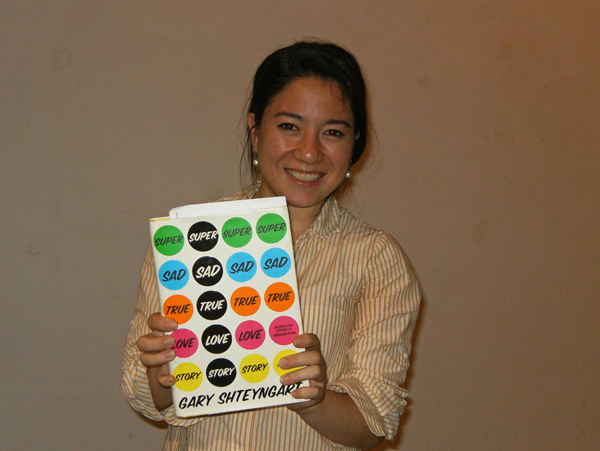
"Super Sad True Love Story" by Gary Shteyngart


"Super Sad True Love Story" by Gary Shteyngart

On Thursday 2nd May 2013, the Hove Book Group (HBG) gathered for another evening of top flight cultural discourse.  Tristan had chosen "Super Sad True Love Story"  by Gary Shteyngart for our consideration.  Tristan has a long and illustrious history of choosing provocative and interesting titles.  To the amazement of the group he confessed that someone at work had suggested this book and, as he happened to have the book on his shelf, he went for it.  Would such a cavalier approach to selecting a book come back to haunt him?

Tristan kicked off the discussion by stating he "really, really liked it" and lauded its "big themes".  

Tristan: "Big themes"
The book is set in the very-near-future: the dollar is in free-fall, the streets are filled with privatised soldiers, China might invade, the information age dominates life.  Most professional jobs are in media or credit. People stream information about each other on their "apparati" (alarmingly smart smart-phones). Books are deeply unfashionable – apart from anything they smell.  Tristan believes that the world depicted in the book is all too plausible, and this book is rich and amusing.  He also took time to praise the Joshie character, and Jeffrey Otter.  And why not?  8.5/10

Hamish" "Modern life is rubbish"
Hamish could not attend in person however conveyed these thoughts... "My Nee-groes, I had such high hopes.  Such high hopes.  A Tristan choice.  A concept seemingly on a par with "The City and The City" (my personal Booker of Bookers).  The downfall of the American dream.  It should have been great.  And to be fair, Gary is a very good writer.  In the sense that he knows and uses the English language quite beautifully at times at least.  Unfortunately, I felt no empathy at all with the characters (except Eunice's mother - "Please forgive you do not understand my English." "I know sometimes life is suck.").  Eunice Park appears selfish.  Lenny is just a dork.  Not in an interesting way.  His colleagues in Post Human Services were even more annoying.  In fact, it was a book full of the types of characters I generally find most tedious in real life.  We all know Modern Life is Rubbish.  Blur told us that years ago.  Not sure that this Super Sad True Love Story gave me any further insights.  It seemed heavily reliant on endless new terminology, some of which was humorous, but not enough to carry the story.  I'm afraid I haven't and won't finish it.  5/10"

Nigel carried on the Tristan love-in.  "He always chooses an interesting book", and usually one that Nigel would never have read otherwise.  Lest we forget it was Tristan who chose 2012's HBG book of the year ("Blindness" by José Saramago).

Nigel stated that, whilst some might say it is wrong to invoke the names of Philip K Dick and Kurt Vonnegut, he reckons Gary Shteyngart's imagination, social satire and storytelling are right up there with those two iconic science fiction satirists. Warming to his theme, he then added he was tempted to invoke the "M" word too: "Masterpiece". Once he started reading the book he became engrossed and picked it up at every opportunity.  The world depicted in the novel feels all too plausible: constantly streaming information about each other on an "apparati"; no books; in essence a future where current social trends (social media, a preoccupation with youth, online pornography etc.) have reached their zenith and inform all aspects of daily life. 

Nigel: "Masterpiece:
Satire needs more than just a prescient and plausible future, and this book also contained a moving portrait of two lonely people - Lenny and Eunice - who, against all the odds, discover mutual love.  Shteyngart manages some great writing too. The tale is told through Lenny's self-absorbed diary entries and Eunice's honest, simple, immediate - but still insightful - social media exchanges. Two very contrasting - but very distinctive - narrative voices.   Here's Lenny describing Eunice's abused mother: "She was pretty, the features economical, the eyes evenly spaced, the nose strong and straight, but seeing her reminded me of approaching a reassembled piece of Greek or Roman pottery. You had to draw out the beauty and elegance of the design, but your eyes kept returning to the seams and the cracks filled with some dark cohesive substance, the missing handles and random pockmarks." Masterly.

Nigel concluded that there is so much richness and detail to enjoy. Shteyngart manages to make all kinds of amusing, chilling and interesting observations about: this dystopian future; Lenny and Eunice's emotional journey; early 21st century Western culture; and the human condition.  It's a compelling, moving, and remarkable book.  9/10

Keith: "Odour"
All eyes turned to Keith, a man whose opinions can never be second guessed.  "...a curious array of post-mortal odours, of which "sardine breath" is the most benign." chuckled Keith.  Keith praised Lenny's pensive diary entries and Eunice's hyperactive social media exchanges on Global Teens, and the way Shteyngart hopped between the deep soulfulness of Russian literature and the world of text acronyms, "Like flicking between Tolstoy and Twitter on an Android".  Will the information age kill the novel along with our attention span?  Keith had no answers.  Keith loved the Italian train station boards at Lenny's work place, another wry smile as he recalled Lenny's mood indicators going from "Meek but cooperative" to "playful/cuddly/likes to learn new things". All too plausible. Sadly.  7/10.

Nick was next up, and quickly observed that this was another tale of doomed love.  Romeo and Juliet, or Tristan and Iseult if you will.  A pair of second generation immigrants: Russian and Korean, who, for all their differences, are both afflicted by low self-esteem.  Lenny's compulsive need to attempt to make others like him, and Eunice's sporadic self-loathing and temper.  Both are burdened by their parents' high expectations, and both have been unlucky in love. They hope their hesitant relationship will keep them safe in a very unsafe world.  An unsafe world where every toxic development has been magnified to unbearable proportions, and given a darkly satiric edge.  Nick found lots to love in Gary Shteyngart's powerful apocalyptic satire spliced with a supersad true love story.  Nick then murmured, "If we are really as oversexed, consumerist, gadget-loving and stupidly superficial as described by Gary Shteyngart will the book's prophetic messages be wasted on us?"  Nick's eyes seemed to suggest the question needed no answer.  7/10

Robin: "Mixed feelings"
Would Hamish's review be the only one out of sync with the otherwise unanimous praise for "Super Sad True Love Story"?  Robin milked the tension, cleared his throat, and then began in his distinctive baritone... "I had mixed feelings about this book...." Robin thought that the writing was clever; the near future setting was executed with aplomb; but he couldn't connect with the characters. After the rupture, the super sad true love story became super sad.  The forced relocation of communities in post-rupture New York echoed the Nazis, and reminded Robin of the apartment scams in post-Glasnost Russia as described in AD Millers 'Snowdrops'. Was the ending bitter-sweet? Or just bitter-bitter?  THIS is New York: Lifestyle Hub, Trophy City.  Quite so.  6.5/10

So Tristan does it again: another interesting, provocative and compelling choice.  HBG eagerly awaits his next book choice.  

Next we turned out attentions to "The Girl From Monday" a 2005 American film directed by Hal Hartley.  After some amusing discussion, we all concluded that this is the worst film HBG has ever discussed.  The words of one critic seeming to sum up our feelings...

"Profoundly unnecessary"

...those of us who had enjoyed "Simple Men" and "Amateur" were baffled by how how Hal Hartley had managed to make such a poor film.  That said, the film made for an interesting companion piece to the book (sex as a commodity, dystopian future etc.), however the low production values, and the slightly hammy acting, undermined an interesting premise. Why even add the extra terrestrial dimension?  Everyone confessed to feelings of boredom and annoyance during the film.  An interesting idea quickly became confused, incoherent and tedious.  Shame.

Finally we discussed "Dear Science" by TV on the Radio.  Tristan and Nick will be attending a festival curated by TV On The Radio.  

Nick loves them, lavishing the album with 9.5/10.  

Tristan remained unconvinced by the album's merits and hopes to be converted once he sees them live.  

Hamish weighed in with an email review: "Hipsters.  I just don't get them.  No, not at all.  I know my HIPNESS RANKING faces a big hit but No."

Nigel recalled Dear Science getting a big thumbs up from critics, and also seeing them appear on Later.  He played this album a few times when it came out, and quite enjoyed it.  Once Tristan had picked it as his HBG musical selection, he played it again, and - as before - he enjoyed it.  So all of this made his inability to remember any of the songs, or feel inspired to keep listening all the more baffling.  It's a good album, by an interesting band, but does it lack something, or does Nigel just need to listen a few more times? 

Keith appreciated the sonic trickery: handclaps, horns, layer upon layer of tasty pop goodness.  Yummy.  

Whilst Robin, who admitted his opinion was based on two YouTube videos that may or may not have been of songs from this album, highlighted the awkward drums and avant jazz squawks, before concluding that Dear Science is both visceral and cerebral.  "I'm gonna shake you, I'm gonna make you come", he whispered.  

And, on that bombshell, HBG called time on the gathering.  Onwards and upwards compadres.  Next time out HBG will be discussing Robin's Italian-tinged choices. 

Friday, 23 November 2012

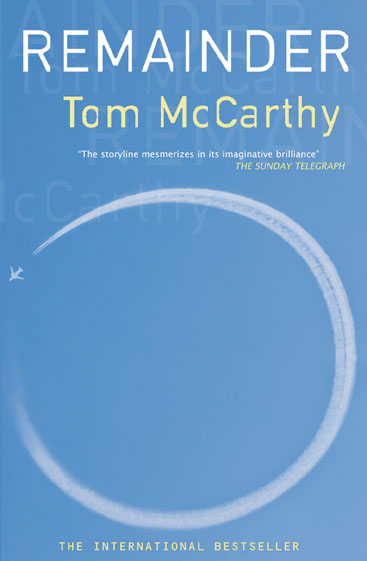
"Remainder" by Tom McCarthy


The Hove Book Group gathered together on Thursday 22nd November 2012 to discuss Keith's choices.

First up was "Remainder" by Tom McCarthy.

"Why Keith?  Why?"

Keith replied that he wanted something modern, new and unknown, and that's what he got from this book.  Original, intriguing, intense, and humorous.

Tom McCarthy couldn’t get Remainder published in the UK at first. He eventually sold it to a French house who marketed it through art galleries rather than bookstores. It proved a critical hit and so was then picked up for a more traditional UK release.

Keith thought it was "an excellent book" and lavished it with an excellent 9/10.

As Keith is a fan of alternative scoring systems, Hamish emailed through a different approach for his review.  Using Kurt Vonnegut's eight rules for story writing he had this to say:

Hamish: alternative scoring system 

Use the time of a total stranger in such a way that he or she will not feel the time was wasted: Was Hamish's time wasted?  The novel was certainly readable enough, dramatic action took place, the story progressed and Hamish kept turning pages.  It wasn’t hard work.  Sadly Hamish felt little emotional attachment to the novel though. Half a Vonnegut

Give the reader at least one character he or she can root for: The narrator totally dominated the book.  None of the other characters were developed enough.  The narrator suffered some mental illness or was just self obsessed and didn’t care.  Either way, Hamish found him vaguely irritating and difficult to relate to.  No Vonneguts 

Every character should want something, even if it is only a glass of water:  The narrator wanted to be real.  Naz initially wanted money but, as the book went on, wanted to feed his addiction to making things run like clockwork.  The other characters presumably just wanted money.  So they did all want something.  But Hamish gave no points because both the narrator and Naz’s desires seemed contrived and plain daft.  No Vonneguts

Every sentence must do one of two things—reveal character or advance the action: Hamish felt that no sentences revealed character.  The action was regularly and dramatically advanced however, although to what end?  Half a Vonnegut

Start as close to the end as possible: The narrator started with the accident and ended with the last re-enactment.  We learned nothing superfluous about his earlier life.  There were no offshoots from the plot, cameo appearances or flowery Rushdiesque descriptions of nearby vegetation.  It was succinct and to the point.  Whatever the point might have been.  One Vonnegut

A sadist
Be a Sadist. No matter how sweet and innocent your leading characters, make awful things happen to them—in order that the reader may see what they are made of:  Sadly nothing awful happened to the narrator.  No Vonneguts

Write to please just one person. If you open a window and make love to the world, so to speak, your story will get pneumonia: Mr McCarthy cannot possibly have written this hoping to make love to the world surely?  The self obsession suggests he wrote it just for himself.  Which is of course how it should be and Hamish scored it  One Vonnegut

Give your readers as much information as possible as soon as possible. To hell with suspense. Readers should have such complete understanding of what is going on, where and why, that they could finish the story themselves, should cockroaches eat the last few pages: The opening page telling us of some awful accident, but the book then actively refuses to give further details.  Early hopes were that things would be explained, it became increasingly evident that they would not.  The narrator/McCarthy actually took some pleasure in not explaining things.  Tom McCarthy utterly failed to make his story similarly believable.  No Vonneguts

So overall, Hamish awarded a grand total of 3 Vonneguts out of a potential 8.  In summary, "a fairly readable pile of complete old tosh".  Tristan converted the "Vonneguts" into the traditional HBG scoring system to reveal a dismissive 4/10.


Nick - used to live in Brixton
Nick, as an ex-Brixton resident, enjoyed the book's Brixton setting.  It was a way in for him.  Alas, after getting in the book never took off.  Too many reconstructions and re-enactments.  Remainder is a novel of ideas. It was clear to Nick that to have any chance of understanding what this book might be about he'd have to pay attention more to the themes than to the events: repetition; the barrier of consciousness from direct experience; the intransigency of matter.  Alas, this approach merely resulted in Nick concluding that this book was Iain Banks-lite.  5/10

Don, quickly got into the book, so much so that he was buoyed.  It was a page turner.  Akin to Blindness.  Don loved the cats...part of the re-enactment of the building and old apartment includes the view from it of a sloping tiled roof on which cats would lie in the sun. This part doesn’t work out so well as the cats placed on the roof keep falling off it and dying. The cats were not enough for Don though.  He demands more than dead cats from his reading, and - as he read on - the book's lack of characters started to annoy, and - at the conclusion of the book - he felt it was only worthy of 6/10.


A cat
Nigel, whilst a fan of Kurt Vonnegut, was not convinced by all of his rules (See Hamish's review above).  Nigel enjoyed the way the book allowed the reader to fill in the blanks.  Nigel was not really sure what it was all about, however he found it beguiling and it sparked off many thoughts and ideas around memory, feelings, experience, time, and life.  

As the book's mysterious councillor reminds the reader towards the book's conclusion: "No less than one hundred and twenty actors have been used. Five hundred and eleven props — tyres, signs, tins, tools, all in working condition — have been assembled and deployed. And that’s just for the tyre shop scene. The number of people who have been employed in some capacity or other over the course of all five re-enactments is closer to one thousand.” He paused again and let the figure sink in, then continued: "All these actions, into which so much energy has been invested, so many man-hours, so much money — all, taken as a whole, confront us with the question: for what purpose?"  For what purpose indeed?  8/10


Tristan

Tristan found the book irritating.  Was it meant to be irritating?  Where was the cleverness?  Tristan felt that the only cleverness was in the madness of the narrator.  Where was the humour?  To what extent is the narrator trustworthy? Is he awake? Was the book a dream? At one dizzying juncture the narrator admits that a conversation he just described didn’t actually happen. Later the narrator is dogged by a smell of cordite. Nobody else can smell it except for one man.  We can’t trust the narrator.  Who can we trust?  4/10

Robin explained he didn't like the book.  Robin recently went to an exhibition in London. By chance he got talking to one of the curators of the exhibition - a sculptor. Robin mentioned that he was reading Remainder. Was sculpture a theme?  The cutting away of stuff until what remains is revealed? Michelangelo spoke of the statue being inside the block of marble already. Cut away the excess material and the statue will be revealed. 3/10


Robin - chance encounter with a sculptor
So, in summary, a book that inspired a mixed set of reactions, and a great discussion.  The average score from Hove's finest - 6/10.

* * * * * * * * * * * * * * * * *


Keith & Nick
With his second choice, Keith wanted to push his own boundaries, and having obsessively perused numerous obituaries he was inspired to find out more about Chris Marker (RIP), and specifically La Jetée (The Pier, 1962).  It's a c30-minute post-third world war story, made up entirely of stills, except for one brief moving shot of a woman opening her eyes. This futuristic photo-novel film was semi-remade by Terry Gilliam as 12 Monkeys in 1995.

Keith felt that La Jetée abstracts cinema almost to its essence in bringing to life the story of a post-apocalyptic man obsessed with an image from his past.  "A little wonder" with fantastic style and excellent images.  Those images endured for Keith.  8/10

Hamish thought that for a short slideshow of photos backed by sounds and narration, this was highly effective.  It reminded him of Godspeed You Black Emperor for some reason.  Hamish enjoyed it.  Five Godspeeds out of a possible seven.  Tristan converted this into a score of 7/10.


Good news for Don
Nick watched the film in French, despite not speaking the language.  When questioned, he was a bit vague on the plot.  He still loved it though.  8/10

Don watched a different film by Chris Marker - San Soleil.  The good news for Don was that the film featured some cats.  Cats and owls were Marker's favourite animals and were a central theme of Sans Soleil.  Don explained that San Soleil also focuses on the weird and the titillating (taxidermied animals in sex poses, an animatronic JFK in a shopping mall).  Marker explains what he sees with the curiosity and empathy of an anthropologist.  San Soleil also has an uneasy relationship with truth.  Don explained that it undermines itself at every opportunity. What is stock footage and what is original? Are scenes separated by geography also separated by years?  Don was unsure.
7/10.
Robin - shocked

Nigel explained the reasons for his high tolerance for art cinema.  These included a woman called Lemmy, carrot cake, coffee in polystyrene cups, and The Electric Cinema in Notting Hill Gate.  Nigel liked the photography and the film's dream-like quality.  7/10

Tristan marvelled at how the still images traced one man's attempt to reclaim an image from his past, and in particular, the poetic, provocative meld of global catastrophe and human frailty.  Why isn't there more of this stuff?  8/10

Robin was also enthused, so much so that he watched both the French version and the English version.  Robin was shocked by the moment the woman blinked - the only moving image in the film. 7/10.


Friday, 13 January 2012

'Room' by Emma Donoghue

Hove Book Group's first gathering of 2012 was on Thursday 12 January to discuss 'Room' by Emma Donoghue.

Tristan explained that he chose this book because it was not a biography and was written by a female author.  He thought the escape scene was dramatic and the TV interview was the heart of the book. Tristan thought it was original, well written, great and gripping.  9/10

Don reached page 82 before leaving the book in a hotel room.  He liked the first 82 pages.

Robin chose not to read the book.  He was reading another book and didn't want to read a book about "child abuse".  Robin wondered if the author made a cynical move to write about a topic that would sell.  Robin's comments sparked a debate about the extent to which the book was about child abuse and the author's motivation.

Keith thought the book was ambitious however thought that the device of the five year old as a narrator stretched credibility and wondered if - consequently - the book lost more than it gained. That said he awarded the book 8/10.

Hamish agreed with Robin and wondered if anyone should be writing about this subject.  He didn't feel the book was very realistic and declined to give it a score.

Nick declared that he was a libertarian and that the author can write anything she wants and that society is judge and jury. Overall Nick was very impressed by the book and gave it 8/10.

Nigel found the early part of the book annoying and distasteful but, after the escape, warmed to it considerably.  Whilst unconvinced that a five year would narrate the story in this way he thought the book was ambitious and occasionally very moving.  Like Tristan, he thought the TV interview was wonderful, describing it as the best thing in the book as it exposed the shallowness and easy stereotypes of most of the mainstream media 8/10.

Jason's partner's all female book group had read and enjoyed the book.  Jason thought it was really interesting how, as males, this book group was more agitated by the content.  Jason devoured the book and thought it was a well told, compelling tale 8/10.

On average Hove Book Group gave 'Room' by Emma Donoghue a score of 8.2.  The book provoked an interesting and, at times, feisty discussion.

Tristan also chose the film 'Somers Town' which is directed by Shane Meadows.

Tristan cuts Shane "a lot of slack" - he liked the music and the cinematography but thought the tale was unbelievable 6/10.

Robin thinks 'Dead Man's Shoes' is "a masterpiece" and so also cuts Shane "some slack".  This is a sweet film but not in the same league as DMS 7/10.

Nigel is also an admirer of the work of Shane Meadows but thinks this is one of Shane's less interesting films  6/10.

Keith was expecting something grittier and characterised this as a tale of youthful innocence 5/10.

Nick is a "massive, massive" Shane Meadows fan and think he is a "genius film maker".  Nick gave this film 7/10.

Next time out the book group will be debating Nick's Celtic-tinged choices.  Watch this space.