Showing posts with label culture. Show all posts

Friday, 7 October 2016

“London and the South-East” (2009) by David Szalay


Hove's finest book group were reunited (and it felt so good) on Thursday 6th October 2016 to discuss Nigel's Sales and Selling themed selections.  Here's another highly unreliable and blinkered view of what went down.

“London and the South-East” (2009) by David Szalay

London and the South-East’ is a melancholic, downbeat novel but one that completely gripped most of us.  Hamish was the one dissenting voice who described it as "a stinker".  

Unlike most novels, work is at the core of this book, and - in this instance - initially at least, it’s the dispiriting world of magazine advertising sales. This is a painfully forensic examination of the horror of the modern workplace and the work "relationships of convenience" that flow from it. Middle-aged Paul Rainey, the borderline-alcoholic protagonist, works for one of those free business magazines that arrive in the post and which no one reads. David Szalay has really nailed the minutiae of the workplace and, in particular, the world of selling. However sales is just the springboard for an unpredictable and original plot that was both realistic and credible, but also frequently very surprising. 

London and the South-East’ is one of the most relatable books we’ve ever read. This sense of realism was further enhanced by our familiarity with many of the Brighton and Hove streets and venues that appear in the book. Most impressively, these places were described with complete accuracy, and this attention to detail informs the entire book. 

London and the South-East’ is a painful exploration of how both work and home form the basis of our identity and our happiness, such as it is, and it’s an unflinching look at commuting, selling, family, identity and compromise. It is bleak, dark, and quite brilliant.

Nigel 9/10 / Tristan 9/10 / Robin 8.5/10 / Hamish 3/10 / Nick 7/10 

MUSIC: “The Who Sell Out” (1967) by The Who 

Nigel expressed joy at the selling theme and especially a link between the film and the music. The film highlights a world that the Beatles and the "British Invasion" of the mid 60s, including The Who, would help to smash with a sledgehammer - but more of that in the film section.

1967 was a year of some remarkable album releases… The Doors debut, Jimi Hendrix debut, Pink Floyd debut, The Velvet Underground and Nico, Love ‘Forever Changes’, Scott by Scott Walker, ‘Something Else’ by The Kinks, and - of course - “The Who Sell Out” (1967) by The Who 

The mid sixties was an era of massive change which this album ably captures.  Consider…

Beatles for Sale (1964)
Help! (1965)
Rubber Soul (1965)
Revolver (1966)
Sgt. Pepper's Lonely Hearts Club Band (1967)

Or

My Generation (1965)
A Quick One (1966)
The Who Sell Out (1967)

Could you imagine such seismic cultural and musical changes in such a short space of time in the modern era?

Despite 1967 seeing the birth of BBC Radio 1, in response to the pirates, commercial radio would still have seemed very new and modern back in 1967 and The Who’s radio ads are a brilliant idea.  Indeed there were no official commercial radio stations in the UK until the early 70s.  Apparently The Who tried to charge the relevant organisations - to no avail.

Any album that contains ‘I Can See For Miles’ is automatically a contender for classic status but, as we discovered it’s also full of other wall-to-wall psych-pop classics.  

The Who Sell Out was the third studio album by The Who and purports to be a broadcast by pirate radio station Radio London. Part of the intended irony of the title was that The Who were making commercials during that period of their career, some of which are included as bonus tracks on the remastered CD.

“Tin Men” (1987) written and directed by Barry Levinson

Tin Men is a 1987 American comedy film written and directed by Barry Levinson.  Tin Men is the second of Levinson's four "Baltimore Films" set in his hometown during the 1940s, 1950s, and 1960s: Diner (1982), Tin Men (1987), Avalon (1990), and Liberty Heights (1999).  It is 1963. Ernest Tilley (Danny DeVito) and Bill "BB" Babowsky (Richard Dreyfuss) are door-to-door aluminum siding salesmen in Baltimore, Maryland. Working for different companies, the "tin men" are prepared to do almost anything—legal or illegal—to close a sale.

An old favourite - man, what a great film - Nigel was a bit worried it wouldn’t be quite so good after a good 15 years since his last viewing.  He needn’t have worried…

Levinson also responsible for Homicide Life On The Streets (by David “The Wire” Simon) - a precursor to so much else - so you can imagine we were somewhat in awe.  


What's good about it?...

Fine Young Cannibals
The Diner
The dynamic between the men
The selling - the scams (life magazine, mental breakdown) - the humour - the period details.  
The highly defined roles of men and women
Men (suits, selling, fighting…) Women (cold calling, typing pool, housewives being sold to..)
The leads - Devito, Dreyfus and Hersh.  What a trio.  All brilliant.
The fight in the parking lock
The commission - is that supposed to echo the Macarthy's House Un-American Activities Committee?

“Tin Men” is one of those movies that has sympathy for all of its characters

Tilley is cantankerous to the point of self-destruction, while BB is a flamboyant ladies’ man who has neglected his inner life. They behave dreadfully during their feud: Bill pretends to be a widower and lies about his occupation to seduce Nora, while Ernest hits Bill over the head and pelts him with mouldy tomatoes and eggs, prompting a hilarious police report.

The Baltimore alleys that would come to feel like very scary places in David Simon’s “The Wire” are already shabby in “Tin Men”

BB to Tilley “You know what our big crime is?  We’re nickle- and-dime guys. Just small-time hustlers that got caught because we were hustling nickles and dimes.” 

It made us feel very nostalgic for a time and a place that we have absolutely no personal experience for and THAT is the sign of a brilliant film.

Endorse it

Here's what we're endorsing at the moment...

Tristan: Stranger Things (Netfilx TV series)
Tristan: Fleabag (BBC TV series on iPlayer)
Nick: Brian Wilson
Robin: Sapiens: A Brief History of Humankind by Yuval Noah Harari (Book)
Hamish: The President's Hat by Antoine Laurain (Book)
NIGEL: The Get Down (Baz Luhrman 2016) (TV - Netflix)
NIGEL: The Get Down (OST 2016) (Music)
NIGEL: All That Man Is by David Szalay (2016) - Book
NIGEL: The Age of Bowie by Paul Morley (2016) - Book

Friday, 3 May 2013

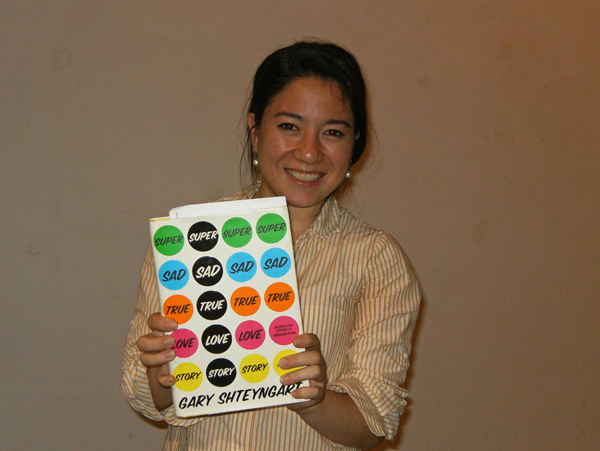
"Super Sad True Love Story" by Gary Shteyngart


"Super Sad True Love Story" by Gary Shteyngart

On Thursday 2nd May 2013, the Hove Book Group (HBG) gathered for another evening of top flight cultural discourse.  Tristan had chosen "Super Sad True Love Story"  by Gary Shteyngart for our consideration.  Tristan has a long and illustrious history of choosing provocative and interesting titles.  To the amazement of the group he confessed that someone at work had suggested this book and, as he happened to have the book on his shelf, he went for it.  Would such a cavalier approach to selecting a book come back to haunt him?

Tristan kicked off the discussion by stating he "really, really liked it" and lauded its "big themes".  

Tristan: "Big themes"
The book is set in the very-near-future: the dollar is in free-fall, the streets are filled with privatised soldiers, China might invade, the information age dominates life.  Most professional jobs are in media or credit. People stream information about each other on their "apparati" (alarmingly smart smart-phones). Books are deeply unfashionable – apart from anything they smell.  Tristan believes that the world depicted in the book is all too plausible, and this book is rich and amusing.  He also took time to praise the Joshie character, and Jeffrey Otter.  And why not?  8.5/10

Hamish" "Modern life is rubbish"
Hamish could not attend in person however conveyed these thoughts... "My Nee-groes, I had such high hopes.  Such high hopes.  A Tristan choice.  A concept seemingly on a par with "The City and The City" (my personal Booker of Bookers).  The downfall of the American dream.  It should have been great.  And to be fair, Gary is a very good writer.  In the sense that he knows and uses the English language quite beautifully at times at least.  Unfortunately, I felt no empathy at all with the characters (except Eunice's mother - "Please forgive you do not understand my English." "I know sometimes life is suck.").  Eunice Park appears selfish.  Lenny is just a dork.  Not in an interesting way.  His colleagues in Post Human Services were even more annoying.  In fact, it was a book full of the types of characters I generally find most tedious in real life.  We all know Modern Life is Rubbish.  Blur told us that years ago.  Not sure that this Super Sad True Love Story gave me any further insights.  It seemed heavily reliant on endless new terminology, some of which was humorous, but not enough to carry the story.  I'm afraid I haven't and won't finish it.  5/10"

Nigel carried on the Tristan love-in.  "He always chooses an interesting book", and usually one that Nigel would never have read otherwise.  Lest we forget it was Tristan who chose 2012's HBG book of the year ("Blindness" by José Saramago).

Nigel stated that, whilst some might say it is wrong to invoke the names of Philip K Dick and Kurt Vonnegut, he reckons Gary Shteyngart's imagination, social satire and storytelling are right up there with those two iconic science fiction satirists. Warming to his theme, he then added he was tempted to invoke the "M" word too: "Masterpiece". Once he started reading the book he became engrossed and picked it up at every opportunity.  The world depicted in the novel feels all too plausible: constantly streaming information about each other on an "apparati"; no books; in essence a future where current social trends (social media, a preoccupation with youth, online pornography etc.) have reached their zenith and inform all aspects of daily life. 

Nigel: "Masterpiece:
Satire needs more than just a prescient and plausible future, and this book also contained a moving portrait of two lonely people - Lenny and Eunice - who, against all the odds, discover mutual love.  Shteyngart manages some great writing too. The tale is told through Lenny's self-absorbed diary entries and Eunice's honest, simple, immediate - but still insightful - social media exchanges. Two very contrasting - but very distinctive - narrative voices.   Here's Lenny describing Eunice's abused mother: "She was pretty, the features economical, the eyes evenly spaced, the nose strong and straight, but seeing her reminded me of approaching a reassembled piece of Greek or Roman pottery. You had to draw out the beauty and elegance of the design, but your eyes kept returning to the seams and the cracks filled with some dark cohesive substance, the missing handles and random pockmarks." Masterly.

Nigel concluded that there is so much richness and detail to enjoy. Shteyngart manages to make all kinds of amusing, chilling and interesting observations about: this dystopian future; Lenny and Eunice's emotional journey; early 21st century Western culture; and the human condition.  It's a compelling, moving, and remarkable book.  9/10

Keith: "Odour"
All eyes turned to Keith, a man whose opinions can never be second guessed.  "...a curious array of post-mortal odours, of which "sardine breath" is the most benign." chuckled Keith.  Keith praised Lenny's pensive diary entries and Eunice's hyperactive social media exchanges on Global Teens, and the way Shteyngart hopped between the deep soulfulness of Russian literature and the world of text acronyms, "Like flicking between Tolstoy and Twitter on an Android".  Will the information age kill the novel along with our attention span?  Keith had no answers.  Keith loved the Italian train station boards at Lenny's work place, another wry smile as he recalled Lenny's mood indicators going from "Meek but cooperative" to "playful/cuddly/likes to learn new things". All too plausible. Sadly.  7/10.

Nick was next up, and quickly observed that this was another tale of doomed love.  Romeo and Juliet, or Tristan and Iseult if you will.  A pair of second generation immigrants: Russian and Korean, who, for all their differences, are both afflicted by low self-esteem.  Lenny's compulsive need to attempt to make others like him, and Eunice's sporadic self-loathing and temper.  Both are burdened by their parents' high expectations, and both have been unlucky in love. They hope their hesitant relationship will keep them safe in a very unsafe world.  An unsafe world where every toxic development has been magnified to unbearable proportions, and given a darkly satiric edge.  Nick found lots to love in Gary Shteyngart's powerful apocalyptic satire spliced with a supersad true love story.  Nick then murmured, "If we are really as oversexed, consumerist, gadget-loving and stupidly superficial as described by Gary Shteyngart will the book's prophetic messages be wasted on us?"  Nick's eyes seemed to suggest the question needed no answer.  7/10

Robin: "Mixed feelings"
Would Hamish's review be the only one out of sync with the otherwise unanimous praise for "Super Sad True Love Story"?  Robin milked the tension, cleared his throat, and then began in his distinctive baritone... "I had mixed feelings about this book...." Robin thought that the writing was clever; the near future setting was executed with aplomb; but he couldn't connect with the characters. After the rupture, the super sad true love story became super sad.  The forced relocation of communities in post-rupture New York echoed the Nazis, and reminded Robin of the apartment scams in post-Glasnost Russia as described in AD Millers 'Snowdrops'. Was the ending bitter-sweet? Or just bitter-bitter?  THIS is New York: Lifestyle Hub, Trophy City.  Quite so.  6.5/10

So Tristan does it again: another interesting, provocative and compelling choice.  HBG eagerly awaits his next book choice.  

Next we turned out attentions to "The Girl From Monday" a 2005 American film directed by Hal Hartley.  After some amusing discussion, we all concluded that this is the worst film HBG has ever discussed.  The words of one critic seeming to sum up our feelings...

"Profoundly unnecessary"

...those of us who had enjoyed "Simple Men" and "Amateur" were baffled by how how Hal Hartley had managed to make such a poor film.  That said, the film made for an interesting companion piece to the book (sex as a commodity, dystopian future etc.), however the low production values, and the slightly hammy acting, undermined an interesting premise. Why even add the extra terrestrial dimension?  Everyone confessed to feelings of boredom and annoyance during the film.  An interesting idea quickly became confused, incoherent and tedious.  Shame.

Finally we discussed "Dear Science" by TV on the Radio.  Tristan and Nick will be attending a festival curated by TV On The Radio.  

Nick loves them, lavishing the album with 9.5/10.  

Tristan remained unconvinced by the album's merits and hopes to be converted once he sees them live.  

Hamish weighed in with an email review: "Hipsters.  I just don't get them.  No, not at all.  I know my HIPNESS RANKING faces a big hit but No."

Nigel recalled Dear Science getting a big thumbs up from critics, and also seeing them appear on Later.  He played this album a few times when it came out, and quite enjoyed it.  Once Tristan had picked it as his HBG musical selection, he played it again, and - as before - he enjoyed it.  So all of this made his inability to remember any of the songs, or feel inspired to keep listening all the more baffling.  It's a good album, by an interesting band, but does it lack something, or does Nigel just need to listen a few more times? 

Keith appreciated the sonic trickery: handclaps, horns, layer upon layer of tasty pop goodness.  Yummy.  

Whilst Robin, who admitted his opinion was based on two YouTube videos that may or may not have been of songs from this album, highlighted the awkward drums and avant jazz squawks, before concluding that Dear Science is both visceral and cerebral.  "I'm gonna shake you, I'm gonna make you come", he whispered.  

And, on that bombshell, HBG called time on the gathering.  Onwards and upwards compadres.  Next time out HBG will be discussing Robin's Italian-tinged choices.