Monday, 21 October 2013

"Complicity" by Iain Banks

And so on 10th October 2013, the Hove Book Group gathered to discuss Hamish's choice "Complicity" (1993) by the late, great Iain Banks.


Hamish kicked things off by heralding the book's big issues: morality, complicity, politics and poetic justice.  Like Cameron, Hamish might well enjoy light drug use, mild S&M, and computer games, unlike Cameron he is less inclined to check out bizarre deaths about which he might, or might not, know more than he cares to admit.  What Hamish could, and did, say, with confidence, is that this book was a total masterpiece and deserved at least 9.5 out of 10.  Wow.

Nigel was similarly enthusiastic, but not quite in agreement with the masterpiece assessment.  Nigel lavished the book with a respectable 7/10, explaining that "Complicity" was an atmospheric, compelling, intelligent Scottish crime thriller that - like the best genre fiction - also has plenty to say on our messed up world and the human condition. Nigel raced through this satisfying story of how dysfunctional local journalist Cameron Colley may have triggered a series of horrific revenge incidents (murder, torture etc.).  The two narrative voices kept this tale tense.  Andy and Cameron are flip sides of the same coin: Cameron talks the talk but doesn't walk the walk, the withdrawn Andy on the other hand... 

Nigel also wondered why the dysfunctional central character was such a common trope in crime writing: an efficient, organised, relatively sober, family man, perhaps even a member of a local book group, never seems to feature at the heart of these books.

Nick had read "Complicity" before and his enthusiasm levels were less pronounced second time around.  With a weary sigh, Nick discussed how sex was a device, how the book was a bit on the long side, and how he felt a bit disappointed.  The bleakness left Nick feeling that he had not been sufficiently challenged.  Are you nihilist enough? An unheroic 5.5/10

For the Don, and sadly via email, Cameron Colley was one of the most loathsome heroes ever to grace a crime novel.  The first criminal act was writing the book. the second was choosing it, and the third was reading it.  Ouch.  No one gets left behind ever on Don's watch.  Except Chris Mullins.  Ripped up and left for dead in the compost bin.  Don did like Andy and this was the book's saving grace.  5/10

Tristan, in stark contrast, is a hard core Banksophile.  The man could do no wrong.  Tristan noted there were actually two Iain Banks: the straight author, and Iain M. Banks the science fiction writer.  Complicity" is vintage Banks, and second only to Crow Road.  Convincing violence, playful, imaginative well written, and - despite being twenty years old - still resonates.  9/10

Keith, again via email, was unconvinced and awarded the book an uncertain 6/10. The larger than life seedy hack who thinks he’s on the trail of something big, is actually a saddo computer gamer.  Keith did not care about him.  The second person narration of Andy’s handiwork is bold but distracting. Pace, intrigue, shock, social commentary, and despite the kinky sex, life-in-the-fast-lane, moral ambiguity and gruesome deaths, Keith demands more.  Much more.

Robin described the book as cliched.  How many more times are we going to have to read about boys wanking each other off in the woods?, he asked a somewhat surprised Hove Book Group.  An inferior anti-Thatcherite fantasy.  Perhaps, and yet, there was a glint in Robin's eyes.    Banks got Robin into the mind of the murderer.  Cameron has to solve all the puzzles via memory.  Robin, like Cameron, got slowly sucked into a world of intrigue, with the stakes rising with each scene. 7/10.

So a mixed reception for "Complicity" and perhaps a bit out of kilter with the broader acclaim for this writer.

We then turned our attention to Hamish's musical selection "In The Heart Of The Moon" (2005) by Ali Farka Touré and Toumani Diabaté

Hamish observed that "In the Heart of the Moon" was a 2005 record by Malian musicians Ali Farka Touré and Toumani Diabaté, the kora king. The music flows effortlessly and beguiles with every listen.

Nigel is unconvinced by much of this type of thing however agreed that is a thing of beauty and a lovely listen.

Robin praised the minimal accompaniment of percussion, bass, guitar and keyboard.  His life is enhanced with each listen of the flowing meditations.

Tristan was seduced by the kora and found his spirits lifted when he focussed on it.

Nick described the album as divine.  

On that moment of harmony and consensus Nick unveiled his ORDINARY => EXTRAORDINARY selections for our next gathering.  

Excited?  I should coco.

Friday, 13 September 2013

"A Month In The Country" by J.L. Carr

"We can ask and ask but we can't have again what once seemed ours for ever..."

Tom Birkin, a damaged World War One veteran, is employed to a find and restore a mural in a village church, whilst another veteran is employed to look for a grave beyond the churchyard walls. The writer looks back 58 years later, and as an old man, on his idyllic Summer of 1920.

Nigel explained that as he gets older he is increasingly drawn to nostalgia and memory.  With over fifty years of life already lived he has more to look back on than, in all probability, to anticipate.  There is a beguiling quality to the way the mind recalls events that happened long ago.  Tom Birkin writes his account of the "cloudless, golden, incomparable summer of 1920" from the perspective of September 1978 and concludes his tale with one of the finest endings Nigel can remember reading:

"We can ask and ask but we can't have again what once seemed ours for ever - the way things looked, that church alone in the fields, a bed on a belfry floor, a remembered voice, the touch of a hand, a loved face. They've gone and you can only wait for the pain to pass. 

All this happened so long ago. And I never returned, never wrote, never met anyone who might have given me news of Oxgodby. So, in memory, it stays as I left it, a sealed room furnished by the past, airless, still, ink long dry on a put-down pen. 


But this was something I knew nothing of as I closed the gate and set off across the meadow."

Nigel first read the book in April 2013 and he knew then that this was his next Hove Book Group choice.  When he realised that his choices would coincide with the summer of 2013 it felt even more appropriate.  

Nigel was so taken with the book that he went on to read another book by J.L. Carr (The Harpole Report) and a biography of J.L. Carr (The Last Englishman by Byron Rogers).  He discovered that there was a strong biographical element to A Month In The Country. Almost everything concerning the Ellerbecks actually happened to J.L. Carr: the visit to the dying girl, the Sunday meal, the preaching, even the organ buying. The Carrs were the Ellerbecks.

Since first reading the book in April the book has stayed with Nigel.  Things Nigel liked about the book:
  • Brevity: a mere 85 pages - and yet it packs so much in
  • The characters: a small but diverse group of characters all of whom are credible and interesting (e.g. Birkin, Moon, Rev Keach, Alice Keach, & the Ellerbecks)
  • Language: simply written, accessible and still so powerfully evoking Oxgodby and Yorkshire, and the long hot summer of 1920. The book is full of passages so well written that Nigel was frequently compelled to re-read and contemplate them.  Nigel could smell the hay, imagine the church, and share Birkin's excitement as the painting was revealed.
  • The powerful themes: the power of art, healing & restoration, love, duty, religion & spirituality, World War 1, trauma, sexuality, intolerance, social history, and, of course, appreciation of life and the good times
The bitter-sweet happiness described by Berkin feels fragile and ephemeral, which makes the story all the more beautiful, powerful and haunting. Nigel thinks it's a masterpiece and everyone should read it.  10/10

Robin and Nigel: In complete harmony
Robin stated that this was the first time in Hove Book Group history that he agreed with Nigel's every word.  Unbelievable.  Robin loved the flow and the catharsis inherent in the novel.  Like Birkin, Robin discovered the gifts of compassion and acceptance, friendship and respect.  For Robin, and like the Summer, the ending came too soon. A magical masterpiece.  9.5/10

Tristan thought the novel was eloquent and immersive and an exemplary study in subtlety.  One of the most beautiful books Tristan has ever read. In an all too brief 85 pages Carr gifts a story that flows like a lazy Yorkshire brook, with stunning characterisation, an indictment of war,  and a celebration of peace, harmony and spirituality.  Understated and subtle genius. 9/10

Keith: No overanalysis here
Keith didn't want to overanalyse the book.  Keith glided through this exquisite recreation of a bittersweet summer which he perceived as a perfect historical novel, and then as an analysis of love and art, before finally settling on a realisation that it embraced the whole human condition: love, pain, healing and rediscovery. A book of restrained beauty that filled Keith's heart with joy.  8/10

Hamish realised, as he read the first few pages, he had read this book before, and JL Carr's "How Steeple Sinderby Wanderers Won the FA Cup".  Whilst not being a fan of novellas, Hamish appreciated how this novella just got on with the job.  Like Birkin, Hamish learnt something about the nature of art, and the healing power of both art and love.  Like Birkin, Hamish became absorbed in the life of the village and its inhabitants.  The book's interweaving narrative threads tied up Hamish in a world of hope and the redemptive power of simple human interaction, of innocence (as personified by Kathy), and of the beauty of nature.  9/10

Nick: Like churches
Nick heralded a remarkable book, before mentioning his love of churches.  If there's a church nearby then that's where you'll find Nick, poking around the knave or up the bell tower.  Nick also felt this was a perfect book to read during Summer, and he had the pleasure of reading it on a beach in northern France.  Nick described it as a hymn to a disappeared rural Britain. 13/10 (yes 13 out of ten - and better than "The Road)

Donvia email, was a little out of step with the acclaim of the rest of the group.  He felt the book modestly ploughed on in an unpretentious way. The unremarkable story had a certain something. Don meandered through the book not knowing if he was enjoying it or merely meeting his obligation as a member of the book club. He did enjoy the description of summer, and the book had him reminscing for his lost youth. 7/10

Overall, an almost unanimous double Macca-style thumbs up from the Hove Book Group who then moved on to discuss  "The Very Best Of The Beach Boys" (2001) by The Beach Boys...

There was a lot of love for The Beach Boys with Nick describing them as his favourite pop group of all time, and universally acclaimed as the sound of summer.  

Hove Book Group agreed how The Beach Boys were a ground breaking, iconic group who came to define the California surfing lifestyle. With a unique sound of close harmony vocals mixed with rock n roll and a huge dollop of boundary pushing studio experimentation, they crafted single after single of poptastic songs about women, cars, having fun, yearning, being in love.  Everyone loves The Beach Boys.  Right?  No actually...

...there was one dissenting voice however, and that voice came from Hamish who texted, having had to leave the gathering early.  Hamish absolutely detests The Beach Boys. He wasn't certain before but now he is. Lightweight meaningless pap he never wants to hear again. Yikes.  What would Brian Wilson say about that?
"This shark, swallow you whole"

_________/)_______\o/_________­_________

And finally, we discussed the last of Nigel's summer themed choices by revisiting the original summer blockbuster, its release regarded as a watershed moment in motion picture history. Yep, we talked about the 1975 American shark film "Jaws" directed by Steven Spielberg and based on Peter Benchley's novel.  

There was much discussion about the film's initial impact and how we agreed that it still held up remarkably well.  Nick recommended everyone read "Easy Riders and Raging Bulls" to fully appreciate the significance of this landmark film.  All of us agreed it retains its ominous feel and sly humour and we enjoyed seeing it again.  Keith took time out to highlight the impact of the film's score.

And, with that, the sun set on a memorable summer, and an appropriate set of choices.


Monday, 22 July 2013

"The Death Of Bunny Munro" by Nick Cave

Keith introduces his Nick Cave fest
On Thursday 18th July 2013, the Hove Book Group took a trip over to the dark side.  Yes, Keith sparked up yet another cigarette before announcing why he had decided to curate a festival of Nick Cave.

It all started with one sweet little taste of the music.  Surely one song won't hurt?  Alas, within a few beats Keith was hooked, and by God he was now hellbent on converting the entire Hove Book Group too.

Don, who has a nose for danger, avoided the whole farrago, claiming he was unavoidably detained in Gloucester, with a Dr Foster.  

Mr Pusherman started by suggesting we read "The Death of Bunny Munro".  It's got a sweet little bunny on the front cover so it must be a lovely little tale we could read to our children.  That's what we were promised.  By the time we were a few pages in it was too late.  Far too late.

Keith let out a cackle as he gazed upon his work.  "So what did you think then?  Did you like my little story?  Did you like my friend Bunny?  Sweet little bunny wunny.  Would you like to have spent more time with him?"


A sweet little bunny
Why Keith?  Why?  

Because it's a classic.  A take it to the max - the Mad Max - extreme.  What about the language?  Oh the language.  What would Caitlin Moran say Keith?  How could you Keith?

Because it's got humour.  Because it's so well written.  Because I have an old sock under my car seat.  Because I hide my hard on with my copy of the Daily Mail.  Because I like it.  Because I say so.  Because you let me choose. Because, because, because.  And because I gave it 7/10.

Hamish actually let his wife read it.  Hamish's wife really liked it.  Hamish found these two "facts" as disturbing as anything in the book.  Hamish, looking ashen faced, said that he "didn't really enjoy it".  5/10.

Robin, with the shiny-eyed messianic stare of the newly converted, shouted "Genius!"  Yes, you heard right.  "Genius!"  Shagging a junkie corpse is not so bad.  We've all done it.  It all makes perfect sense.  Who needs a moral compass?  Who needs a compass?  Follow your groin.  9/10 from this cocksman.


Nick "lost his mojo"
Nick was not so convinced, bandying words and phrases like "lost his mojo", "iniquitous", "gone off the boil", "tedious", "waste of space", "perfidious", "gone to the dogs".  Where's the humanity?  I trusted you Nick.  You. Betrayed. Me. 2/10

Nigel wanted to like it.  He really did.  He's a fan you see. He saw Nick and Will Self at a launch event for the book.  The father-son relationship echoes "The Road".  Or does it?  Bunny barely registers his son's needs and feelings, and registers only the vaguest sense of love or responsibility. Bunny Munro is a monstrous character: vain, sex obsessed, egotistical, and deluded. Having created this monster, Nick Cave seems unsure what to do with him and the novel is essentially a sequence of meaningless attempted sexual encounters. There is no character development. Bunny's limited self-insight gives the character nowhere to go and his devoted son can barely work out what is going on. It all feels like a short story expanded into an overlong novel. Even the black humour generally falls wide of the mark. 4/10. 


Tristan was all about the splayed buttocks.  Vile filth, depravity, raw power, Butlins.  Yes Butlins.  Our True Intent is all for Your Delight.  Unlike "Hangover Square" the descent into alcoholism and self destruction was unrealistic.  The damage was shelf inflicted.  Where were the thundering old testament prophets?  The whiskey priests?  The horned killer?  OK, we'll give you the horned killer.  6/10


The Proposition
Keith saw all that he had made, and it was very good.  Wiping the splattered blood from his brow, he offered us The Proposition.  Was it historically accurate?  Does it matter?  It. Is. Believable. 7/10

Robin likes depravity, violence, and spaghetti.  7/10

Tristan praised the costumes, and the cinematography, and the slight flaws. 7/10

Nick was reminded of Mad Max.  Epic. 7/10

Hamish likes Australia, more than the USA. 7/10

Nigel says yes to Guy, Ray, Danny, John, David and Emily - and Nick and John H.  7/10

And, so finally, we were ready to face the music.  Live Seeds.  Fresh from a Nick Cave and the Bad Seeds performance at Glastonbury, Keith was full of praise for Nick Cave who is his new favourite artist in the world ever.  I love it.  I LOVE IT. 9/10.


Robin didn't listen to it.  He was too busy listening to Mumford and Sons.  Perhaps.  Or just
Robin of Wildlife SOS takes another emergency call
too busy.  T
oo busy responding to Wildlife SOS calls.  


Nick loves The Mercy Seat.  It's his favourite song ever written.  Really.  He can't get enough of it.  He likes it more than Billie Jean, and Thriller. 7/10

Hamish, whilst stroking his chin, declared it was "an interesting album".  A departure from The Birthday Party. 8/10

Nigel likes it very much.  7/10

And so, with the rueful grins that frequently characterise trauma victims, and some chat about cartoon cats, the Hove Book Group broke up for the Summer.  Yes, it's the last gathering until September 2013.  In the meantime the band of brother's have Nigel's Summer-themed choices to sustain them through the long hot Summer.  

Remember the sun cream and wide brimmed stetsons.   Adios Amigos.


Friday, 7 June 2013

"The Talented Mr Ripley" by Patricia Highsmith

Old school
The Hove Book Group was back together on the evening of Thursday 6th June 2013 to discuss Robin's choices.  

Robin's book choice was "The Talented Mr Ripley" by Patricia Highsmith 

Robin kicked things off by describing how he is "a convert" to Italy and all things Italian, and this informed  his choices for Hove Book Group.  

In addition to reading the book, Robin had also watched the 1999 film adaptation directed by Anthony Minghella and staring Matt Damon and Jude Law.  The recollection of Jude Law prompted Robin to describe his strong physical attraction towards Mr Law.  Don stated that "coming out during a book review is a Hove Book Group first".  Quite so. 7/10

Tristan praised Ms. Highsmith's credible evocation of men.  The character development of Tom Ripley is what makes The Talented Mr. Ripley one of the great crime novels of the 20th century. Ms. Highsmith is an acute observer, and is able to translate her sensitivity into a multidimensional portrait of a successful criminal in a way that is virtually unmatched.  Tristan concluded with a bit of customary pedantry - something about blood stains - before lavishing the book with 7/10.


Robin: Came out
Nigel explained that this was the second time he'd read the book.  The first time was back in 2000, when he too was inspired by the 1999 film adaptation . Nigel stated that it was good to reread the book without the film adaptation fresh in his mind.  Tom Ripley is a deeply flawed individual, who - whilst clever and cunning - takes foolish risks and makes occasional mistakes. These mistakes ratcheted up the tension for Nigel.  It's a compelling tale of how the opportunistic and amoral Tom Ripley takes advantage of situations. All told from Tom Ripley's perspective, and somehow, despite his reprehensible behaviour, Patricia Highsmith had Nigel rooting for him throughout. The book is full of insights into Ripley's character, including short flashbacks to his dysfunctional childhood that credibly help to explain his personality and behaviour. Ripley is a fantastic character, and this is a well written, psychological thriller. 8/10

Nick picked up the theme of rooting for Tom Ripley, suggesting his underdog status illicits our sympathy. We meet Tom Ripley almost as casually as new friends do. It's only by following him around, hearing his thoughts and observing what he does that we realize who he is. Ripley is an immensely capable man but also extremely impulsive. If there's an opportunity he'll take it.  The ultimate anti-hero?  8/10


Hamish: Confused
Hamish was confused.  Confused until Mr Murder came a-calling.  From that moment on everything made sense and Hamish was gripped.  Ripley looks for neither approval nor acclaim. Solitude is his middle name.  The book's core theme is around identity. Who are we? Can we reinvent ourselves? How do judge others? Hamish could not remember any other crime novel that explores such subtle questions so effectively. 7/10

Don described it as a "masterpiece of crime fiction". Once Ripley is sent to Europe as a paid-for emissary with an expense account he develops a taste for la dolce vita. When his new friendship is threatened, along with his new lifestyle, he takes decisive action.  What follows was, for Don, one of the most interesting and intricate plot lines that Don had ever read.  Right up there with W. Somerset Maugham's Ashenden.  High praise indeed.  8/10


Don: Masterpiece of crime fiction


Keith stated that the book begins with an edginess that doesn't relent until the final sentence.  Highsmith took Keith on a dark rollercoaster ride of deception, jealousy, deceit, murder, lies, and evasion.   There's no senseless violence, just dispassionate pragmatism.  Keith was mesmerised as Ripley managed to just about stay one step ahead of the police. The result was riveting.  To his shock and amazement, Keith realised he was sympathising with a cold and calculating killer. Keith also praised Ms. Highsmith's ability to exquisitely capture the 1950s milieu of the book, particularly  the life of a wealthy American abroad. Her writing is elegant and simple and well worthy of 7/10.


Universal acclaim for "The Talented Mr Ripley" by Patricia Highsmith from Hove's finest, and a strong contender for the coveted HBG Book Of The Year Award.

Robin's cinematic choice Berberian Sound Studio directed by Peter Strickland and starring TobyJones, and Cosimo Fusco.  

After reading rave reviews, Robin was looking forward to this film and was expecting a treat. Sadly, he was left confused whilst watching a film which didn't make sense, and where not much happened.  One of the most awful, pretentious films Robin has ever seen and a complete waste of time. 2/10

Tristan reminded us of his high threshold for pretentiousness, before describing how much he enjoyed this film.  For Tristan this was a brilliant study of one man's unhinged descent into the dark underbelly of Italian life.  A claustrophobic sound studio devoid of natural light where an awkward sound effects recordist fragments whilst witnessing unseen horrors at The Berberian Sound Studio. 7/10

Nigel continued the love for Berberian Sound Studio.  Nigel enjoyed the 1970s styling and was blown away by the performance of Toby Jones, who gives a masterclass in acting and alienation.  The film is beautifully shot and full of black humour.  Fantasy bleeds into reality, sounds and dreams blur into each other to form a paranoid nightmare, as the film gradually eats itself.  Cinematic perfection.  9/10

Nick evoked David Lynch, and felt this film shared many of the master's qualities, whilst bandying around words like disconcerting, chilling, and gripping   Nick is partial to a bit of 1970s Italian gore-horror, and enjoys directors like Dario Argento and Lucio Fulci.  For Nick, the film's key is around the importance of sound.  Beautifully directed. 6/10.

Finally we discussed Puccini's Madama Butterfly.  Don loved it having taken the time to absorb the plot and immerse himself in the music.  Robin recommended a visit to Verona to attend open air opera.  The rest of us were less convinced.

Friday, 3 May 2013

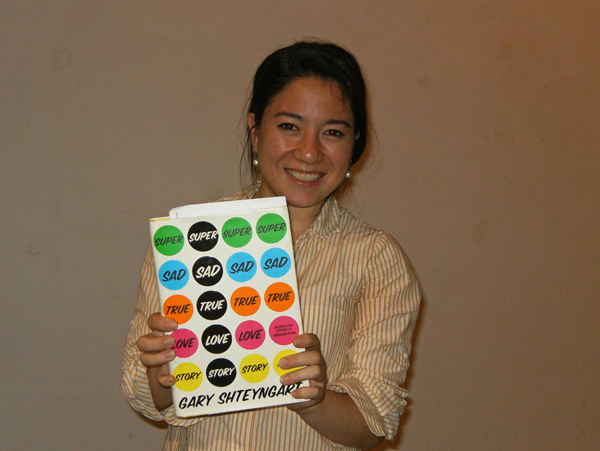
"Super Sad True Love Story" by Gary Shteyngart


"Super Sad True Love Story" by Gary Shteyngart

On Thursday 2nd May 2013, the Hove Book Group (HBG) gathered for another evening of top flight cultural discourse.  Tristan had chosen "Super Sad True Love Story"  by Gary Shteyngart for our consideration.  Tristan has a long and illustrious history of choosing provocative and interesting titles.  To the amazement of the group he confessed that someone at work had suggested this book and, as he happened to have the book on his shelf, he went for it.  Would such a cavalier approach to selecting a book come back to haunt him?

Tristan kicked off the discussion by stating he "really, really liked it" and lauded its "big themes".  

Tristan: "Big themes"
The book is set in the very-near-future: the dollar is in free-fall, the streets are filled with privatised soldiers, China might invade, the information age dominates life.  Most professional jobs are in media or credit. People stream information about each other on their "apparati" (alarmingly smart smart-phones). Books are deeply unfashionable – apart from anything they smell.  Tristan believes that the world depicted in the book is all too plausible, and this book is rich and amusing.  He also took time to praise the Joshie character, and Jeffrey Otter.  And why not?  8.5/10

Hamish" "Modern life is rubbish"
Hamish could not attend in person however conveyed these thoughts... "My Nee-groes, I had such high hopes.  Such high hopes.  A Tristan choice.  A concept seemingly on a par with "The City and The City" (my personal Booker of Bookers).  The downfall of the American dream.  It should have been great.  And to be fair, Gary is a very good writer.  In the sense that he knows and uses the English language quite beautifully at times at least.  Unfortunately, I felt no empathy at all with the characters (except Eunice's mother - "Please forgive you do not understand my English." "I know sometimes life is suck.").  Eunice Park appears selfish.  Lenny is just a dork.  Not in an interesting way.  His colleagues in Post Human Services were even more annoying.  In fact, it was a book full of the types of characters I generally find most tedious in real life.  We all know Modern Life is Rubbish.  Blur told us that years ago.  Not sure that this Super Sad True Love Story gave me any further insights.  It seemed heavily reliant on endless new terminology, some of which was humorous, but not enough to carry the story.  I'm afraid I haven't and won't finish it.  5/10"

Nigel carried on the Tristan love-in.  "He always chooses an interesting book", and usually one that Nigel would never have read otherwise.  Lest we forget it was Tristan who chose 2012's HBG book of the year ("Blindness" by José Saramago).

Nigel stated that, whilst some might say it is wrong to invoke the names of Philip K Dick and Kurt Vonnegut, he reckons Gary Shteyngart's imagination, social satire and storytelling are right up there with those two iconic science fiction satirists. Warming to his theme, he then added he was tempted to invoke the "M" word too: "Masterpiece". Once he started reading the book he became engrossed and picked it up at every opportunity.  The world depicted in the novel feels all too plausible: constantly streaming information about each other on an "apparati"; no books; in essence a future where current social trends (social media, a preoccupation with youth, online pornography etc.) have reached their zenith and inform all aspects of daily life. 

Nigel: "Masterpiece:
Satire needs more than just a prescient and plausible future, and this book also contained a moving portrait of two lonely people - Lenny and Eunice - who, against all the odds, discover mutual love.  Shteyngart manages some great writing too. The tale is told through Lenny's self-absorbed diary entries and Eunice's honest, simple, immediate - but still insightful - social media exchanges. Two very contrasting - but very distinctive - narrative voices.   Here's Lenny describing Eunice's abused mother: "She was pretty, the features economical, the eyes evenly spaced, the nose strong and straight, but seeing her reminded me of approaching a reassembled piece of Greek or Roman pottery. You had to draw out the beauty and elegance of the design, but your eyes kept returning to the seams and the cracks filled with some dark cohesive substance, the missing handles and random pockmarks." Masterly.

Nigel concluded that there is so much richness and detail to enjoy. Shteyngart manages to make all kinds of amusing, chilling and interesting observations about: this dystopian future; Lenny and Eunice's emotional journey; early 21st century Western culture; and the human condition.  It's a compelling, moving, and remarkable book.  9/10

Keith: "Odour"
All eyes turned to Keith, a man whose opinions can never be second guessed.  "...a curious array of post-mortal odours, of which "sardine breath" is the most benign." chuckled Keith.  Keith praised Lenny's pensive diary entries and Eunice's hyperactive social media exchanges on Global Teens, and the way Shteyngart hopped between the deep soulfulness of Russian literature and the world of text acronyms, "Like flicking between Tolstoy and Twitter on an Android".  Will the information age kill the novel along with our attention span?  Keith had no answers.  Keith loved the Italian train station boards at Lenny's work place, another wry smile as he recalled Lenny's mood indicators going from "Meek but cooperative" to "playful/cuddly/likes to learn new things". All too plausible. Sadly.  7/10.

Nick was next up, and quickly observed that this was another tale of doomed love.  Romeo and Juliet, or Tristan and Iseult if you will.  A pair of second generation immigrants: Russian and Korean, who, for all their differences, are both afflicted by low self-esteem.  Lenny's compulsive need to attempt to make others like him, and Eunice's sporadic self-loathing and temper.  Both are burdened by their parents' high expectations, and both have been unlucky in love. They hope their hesitant relationship will keep them safe in a very unsafe world.  An unsafe world where every toxic development has been magnified to unbearable proportions, and given a darkly satiric edge.  Nick found lots to love in Gary Shteyngart's powerful apocalyptic satire spliced with a supersad true love story.  Nick then murmured, "If we are really as oversexed, consumerist, gadget-loving and stupidly superficial as described by Gary Shteyngart will the book's prophetic messages be wasted on us?"  Nick's eyes seemed to suggest the question needed no answer.  7/10

Robin: "Mixed feelings"
Would Hamish's review be the only one out of sync with the otherwise unanimous praise for "Super Sad True Love Story"?  Robin milked the tension, cleared his throat, and then began in his distinctive baritone... "I had mixed feelings about this book...." Robin thought that the writing was clever; the near future setting was executed with aplomb; but he couldn't connect with the characters. After the rupture, the super sad true love story became super sad.  The forced relocation of communities in post-rupture New York echoed the Nazis, and reminded Robin of the apartment scams in post-Glasnost Russia as described in AD Millers 'Snowdrops'. Was the ending bitter-sweet? Or just bitter-bitter?  THIS is New York: Lifestyle Hub, Trophy City.  Quite so.  6.5/10

So Tristan does it again: another interesting, provocative and compelling choice.  HBG eagerly awaits his next book choice.  

Next we turned out attentions to "The Girl From Monday" a 2005 American film directed by Hal Hartley.  After some amusing discussion, we all concluded that this is the worst film HBG has ever discussed.  The words of one critic seeming to sum up our feelings...

"Profoundly unnecessary"

...those of us who had enjoyed "Simple Men" and "Amateur" were baffled by how how Hal Hartley had managed to make such a poor film.  That said, the film made for an interesting companion piece to the book (sex as a commodity, dystopian future etc.), however the low production values, and the slightly hammy acting, undermined an interesting premise. Why even add the extra terrestrial dimension?  Everyone confessed to feelings of boredom and annoyance during the film.  An interesting idea quickly became confused, incoherent and tedious.  Shame.

Finally we discussed "Dear Science" by TV on the Radio.  Tristan and Nick will be attending a festival curated by TV On The Radio.  

Nick loves them, lavishing the album with 9.5/10.  

Tristan remained unconvinced by the album's merits and hopes to be converted once he sees them live.  

Hamish weighed in with an email review: "Hipsters.  I just don't get them.  No, not at all.  I know my HIPNESS RANKING faces a big hit but No."

Nigel recalled Dear Science getting a big thumbs up from critics, and also seeing them appear on Later.  He played this album a few times when it came out, and quite enjoyed it.  Once Tristan had picked it as his HBG musical selection, he played it again, and - as before - he enjoyed it.  So all of this made his inability to remember any of the songs, or feel inspired to keep listening all the more baffling.  It's a good album, by an interesting band, but does it lack something, or does Nigel just need to listen a few more times? 

Keith appreciated the sonic trickery: handclaps, horns, layer upon layer of tasty pop goodness.  Yummy.  

Whilst Robin, who admitted his opinion was based on two YouTube videos that may or may not have been of songs from this album, highlighted the awkward drums and avant jazz squawks, before concluding that Dear Science is both visceral and cerebral.  "I'm gonna shake you, I'm gonna make you come", he whispered.  

And, on that bombshell, HBG called time on the gathering.  Onwards and upwards compadres.  Next time out HBG will be discussing Robin's Italian-tinged choices. 

Wednesday, 20 March 2013

Caitlin Moran "How To Be A Woman"

Caitlin Moran on hearing Don's comments
On Tuesday 19th March 2013 Hove Book Group met up for another evening of top flight cultural discourse.  Here is an eye witness account of what went down.

Nick implored the group to explore their female sides with three selections that took us down Equality Avenue.  We came to the event having all read Caitlin Moran's best selling book "How To Be A Woman".  Nick felt the book was mis-sold and was more about Caitlin than a generic book about women.  Nick likes to think of himself as someone sympathetic to feminism, as long as it doesn't involve too much shouting at men that is. Despite this modern and enlightened approach Nick felt the book did not offer much more than some great one-liners and sporadic wisdom - specifically the sections on abortion and child birth.  A good read.  6/10

To Nigel, a renowned 50 something liberal male, Caitlin Moran is preaching to the converted.  There's very little in her book for him to disagree with.  He will encourage his daughter to read it once she is 15 or 16.  Nigel felt there were some parts of the book where Caitlin could have been far more succinct without diluting the message.  Nigel ran through the notes he had made at the end of each chapter.  Some chapters were far more successful than others.  The ones that Nigel thought were most effective included "I Start Bleeding", "I Become Furry" ,"I am Fat", "I Encounter Some Sexism", "I Am In Love", "I Get Married", "I Get Into Fashion", and "Abortion".  Nigel took issue with Caitlin's support of celebrity gossip magazines, "Buying them only encourages them and their agenda to undermine women Caitlin".  Her style is fairly strident and opinionated which might not be to everyone's taste, and some sections are a little overlong, but fundamentally it's a wise and funny book with some helpful and thoughtful insights.  7/10  


Before the meeting there had been some speculation about Don's reaction to this book.  Previous books that Don disliked having been shredded, thrown on a compost bin etc. Don confessed that this was a new genre for him and that he really liked Caitlin's column in The Times newspaper.  So far, so encouraging, alas he then stated that a lot of the content had already appeared in her newspaper columns, that she was "fine in small doses" before a parting shot that this book was "witless, turgid and unfunny".  Don stopped reading on page 161.  Ouch.  Take that Caitlin Moran.


Don said what?!
Jason's wife had read him some funny sections of the book a few months before this gathering, and so inspired Jason to read the whole thing.  Once Jason sat down and started reading "How to Be a Woman" properly he felt he'd already heard the best bits.  That said, by the time Caitlin Moran stated "in many ways, there is no crueller or more inappropriate present to give a child than oestrogen and a big pair of tits. Had anyone asked me I think I would have requested a book token or maybe a voucher for C&A instead", Jason realised he was reading a helpful book and as Caitlin states, "I'm neither 'pro-women' nor 'anti-men'. I'm just 'Thumbs up for the six billion."  "Right on", murmured Jason. 6.5/10

Robin lost his kindle on a plane and, with it, his copy of this book.  Nigel's copy arrived too late for him to finish it.  Doh!  Robin then digressed, and described how none of his girlfriends had ever engaged in masturbation.  Whilst the group digested this sensational news, Robin then questioned the extent to which Caitlin had masturbated.  Robin felt this was a book that might as well have been subtitled "common sense, with some jokes and improbably high levels of masturbation". 5/10


Caitlin hears Robin's remarks about female masturbation
Hamish felt this was not a book about feminism, rather a book about Caitlin and modern life.  His wife had found it hilarious, Hamish less so.  Was it more funny to female readers?  The jokes are integral to the book. Hamish thought her account of the birth of her first child was absolutely brilliant; and her husband's tears at her suffering is beautifully and memorably described. She can also squeeze in a gag on how the whole experience has given her perspective: "I doubt that I will get angry about Norwich Union changing its name to 'Aviva' ever again." 5/10

Keith stated that this was his kind of feminism and Caitlin was his kind of woman.  Great news.  Persuasive, honest, passionate, inclusive.  Keith was impressed by Caitlin and her book. The book's achievement is to make feminism seem unthreatening and simple. Caitlin is not anti-men and believes that we're all just "The Guys", that sexism is just a form of bad manners, and that one thing that would help is more imaginative porn.  Keith says a hearty "Yes" to all of the above.  9/10


Tristan heartily enjoyed it.  A funny, liberal book.  Tristan then distributed an eye opening photo of Germaine Greer to illustrate a point about female-centric pornography.  Tristan stated that it is really important that we talk about this stuff and understand it.  That Caitlin Moran's book is also engaging, brave, clever, and funny is a bonus.  Everybody should read it.  8.5/10 

An interesting debate with a variety of views - with most participants from Hove's number one book group feeling that this was a well written book with humour, insight and power.  Thank you Caitlin Moran.


The Pixies' legendary female bassist informed Nick's musical choice "Doolittle" by The Pixies....


Sadly at this point the notes became a series of illegible scrawls and crude and childish drawings.

The Allmusic review concludes with "A fun, freaky alternative to most other late-'80s college rock, it's easy to see why the album made the Pixies into underground rock stars."  Broadly speaking: 


Nick and Nigel are fans and very positive about the band and this album.


Jason and Robin don't like it.


Keith, Hamish and Tristan were only partly convinced by it.


Thelma and Louise
Finally the group discussed the film "Thelma and Louise".

Despite some dreadful music, Nick really enjoyed this film.


Nigel loved it when it first came out, however felt it had dated badly and was struck by the almost universal overacting.  Still watchable but not as good as it seemed all those years ago.


Once again, at this point the meeting notes degenerate into stream of consciousness mumbo jumbo and arcane symbols that not even the experts at the British Museum could interpret.  


The end.